Almost every guide on this subject makes the same mistake in its first sentence. It says offshore casinos are illegal, leaves it there, and lets the reader assume that means illegal for them. In most countries it does not.

Licensed vs Offshore Casinos Explained


The short answer: A licensed casino holds a permission from the regulator of the country it serves you in. An offshore casino holds a licence somewhere else and serves your country anyway. In almost every market, offering that service without local permission is the operator’s offence, not yours. Two countries are genuine exceptions, and they matter.
Who Is Actually Breaking the Law
In Sweden, Germany, the Netherlands, Norway, Finland, Canada, Brazil and New Zealand, the legislation is written at operators. It creates offences for offering unlicensed gambling, powers to block domains, and duties on banks to stop payments. Nothing found in any of those regimes creates an offence for the person placing the bet.
That is not a licence to relax. It means the risk you carry is a different kind: no protection, no route to complain, and in one case a tax bill.
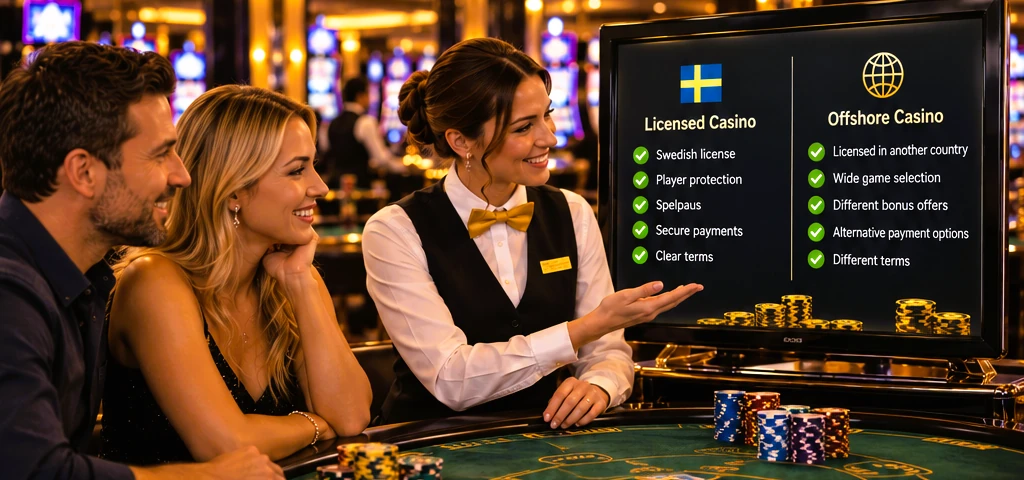
The two real exceptions: In Japan, placing a bet from inside the country has long been an offence under Penal Code Articles 185 and 186, whatever country the server sits in, and 57 ordinary users were referred to prosecutors in November 2024. In India, the online gaming rules that came into force on 1 May 2026 prohibit real money online gaming outright, including games of skill.
The Ten Markets, Side by Side
| Market | Regulator | Local licensing? | Where the offence sits |
|---|---|---|---|
| Sweden | Spelinspektionen | Yes, since 1 January 2019 | The operator. A 2025 inquiry proposes widening this from 2027, not yet law |
| Germany | GGL, in Halle | Yes, since 1 July 2021 | The operator |
| Netherlands | Kansspelautoriteit | Yes, since 1 October 2021 | The operator, with domain and payment blocking powers |
| Norway | Lotteritilsynet | No, state monopoly only | The operator, plus duties on banks to block gambling payments |
| Finland | National Police Board, then the Supervisory Agency | Monopoly now, licensing from 2027 | The operator, but offshore winnings are taxable for the player |
| Canada, Ontario | AGCO and iGaming Ontario | Yes, since 4 April 2022 | The operator. Other provinces run their own monopolies |
| Brazil | Secretaria de Premios e Apostas | Yes, since 1 January 2025 | The operator |
| India | Online Gaming Authority | No, real money gaming prohibited | Operators and payment providers, and the prohibition is general |
| Japan | No online regime | No | The player as well as the operator |
| New Zealand | Department of Internal Affairs | Act passed, operating from 2027 | The operator |
What Changes When You Play Outside Your Own Market
Four things move, and none of them is the reason people assume. The games are the same, the studios are the same and the money is real either way. What differs is the machinery around a dispute.
- Self-exclusion stops working. A national register binds the operators licensed in that country and nobody else. Spelpaus says so in its own material: licensed companies must check it at every registration and login, and offshore sites are simply out of scope. The full picture is in national self-exclusion registers
- Your complaint has nowhere to go. A dispute with a licensed operator has an escalation path. A dispute with an operator outside your regime has whatever that operator’s own licence provides, and how far a complaint can actually go varies enormously between them
- Deposits may simply stop working. Norway requires payment providers to block gambling merchant codes, and India bars payment processors from handling prohibited games. That is not your bank being awkward, and it is one of the causes in why was my casino deposit declined
- The tax treatment can flip. See below, because this one is concrete and expensive
The Finnish Tax Trap
Here is a specific, documented cost of choosing an offshore casino over a licensed one, from a national tax authority rather than from an affiliate site.
Finland’s tax administration has ruled that winnings from gambling organised in Finland, or in another EU or EEA state under that state’s own legislation, are exempt from income tax under section 85 of the Income Tax Act. Winnings from gambling organised outside that area, which includes a Curacao licensed site, are taxable as earned income at ordinary progressive rates under sections 29 and 61. Only directly linked costs are deductible, and losses are not.
What that means in practice: The same win, from two casinos, can be tax free from one and taxed at your marginal rate from the other. The variable is not where you are, it is where the casino is licensed. That is the clearest financial argument for choosing a licensed operator that exists.
This is general information rather than tax advice, and rules change, so check with your own tax authority before relying on it. The wider picture across markets is in do you pay tax on casino winnings.
Not All Offshore Licences Are the Same
Offshore is not one thing. A Malta licence and a licence with no functioning complaints process are both offshore relative to a Swedish player, and they behave nothing alike when something goes wrong. What separates them is whether there is an enforcement body behind the certificate, which is what comparing the licences really comes down to, with detail on Malta and Curacao separately.
How to Tell Which You Are Looking At
- Find the licence number in the footer and look it up on the regulator’s own register, not on a page the casino controls
- Check that the regulator named is the regulator for your country, not simply a regulator somewhere
- See whether the site names an approved dispute resolution body. Licensed operators in most regimes are required to
- Check whether the currency, deposit limits and bonus rules match your market’s requirements. A German facing site that lets you spin faster than every five seconds is not operating under the German regime
So Which Should You Actually Play At?
There is a real trade here and it is worth pricing rather than being told. A locally licensed operator gives you self exclusion that binds, a complaints route that exists and, in some markets, a better tax outcome. It also gives you whatever that market restricts: one bonus per player in Sweden, capped stakes and spin speeds in Germany, no bonuses at all in Spain for new customers. Offshore operators give you the opposite of both, larger offers and thinner recourse.
Which side of that suits you depends on how much protection you actually expect to need and how much the restrictions cost you in practice. What is not sensible is picking one without knowing which you picked, and casinos grouped by the regulator behind them makes that visible in a glance. The operators available in your own country is the faster route if you already know your market.
Frequently Asked Questions
In most markets, no. The legislation creates offences for operating without a licence, not for placing a bet, and it also gives regulators powers to block domains and payments. Japan is a genuine exception, where betting from inside the country is an offence in itself, and India prohibits real money online gaming generally since 1 May 2026.
A casino licensed somewhere other than the country it is serving you in. A Curacao or Malta licensed site accepting Norwegian players is offshore from Norway’s point of view. It is not a description of quality, since a strong regulator and a weak one can both be offshore relative to you.
Criminally, almost nowhere except Japan and, since May 2026, India. Practically, yes in ways that cost money: self-exclusion registers do not cover the operator, no dispute body will hear your complaint, payments may be blocked, and in some countries the winnings become taxable when a licensed win would not have been.
Norway and, until its 2027 reform, Finland run state monopolies with no private licensing. India prohibits real money online gaming outright since May 2026. Japan has no online licensing regime and treats betting from within the country as an offence. Sweden, Germany, the Netherlands, Ontario, Brazil and now New Zealand all license private operators instead.
Many do, routinely. The difference is what happens when one does not. With a licensed operator there is an escalation route and a regulator with sanctions. With an operator outside your regime, your recourse depends entirely on which regulator it does answer to, and some of them explicitly decline to handle individual disputes.
For the player, in most countries yes. What a Curacao licence changes is the protection behind it rather than the legality of your play. It is worth knowing that Curacao’s own authority states it does not handle individual complaints against operators, which is a meaningful difference from regimes that route disputes to an approved body.
Because it is not licensed to accept you, and blocking you is the operator behaving correctly. An operator willing to take a deposit it is not permitted to take is showing you how it will behave when you want that money back.
It changes nothing legally and makes your position worse contractually. Operator terms treat disguising your location as a prohibited practice, and the consequence is usually account closure with the balance withheld. What operators actually detect, and what they do about it, is a separate question with a longer answer.
Several are in motion. Finland opened licence applications on 1 March 2026 with the market launching in 2027, and New Zealand has passed its Act with operation expected in 2027. Sweden has a pending proposal to widen what counts as unlicensed activity, aimed at 2027, which is not yet law.
Sometimes, and this is one of the most concrete costs. Finland’s tax authority treats winnings from an EU or EEA licensed operator as exempt and winnings from outside that area as taxable earned income. Rules differ by country and change, so check with your own tax authority rather than relying on a guide.
New Casinos

Slots
Live Casino
Sports Betting
100%
Up to €100
300 Free Spins
+ €35 Free Bets
Min Deposit
€10

Slots
Live Casino
Sports Betting
100%
Up to €100
150 Free Spins
+ €15 Free Bets
Min Deposit
€10


