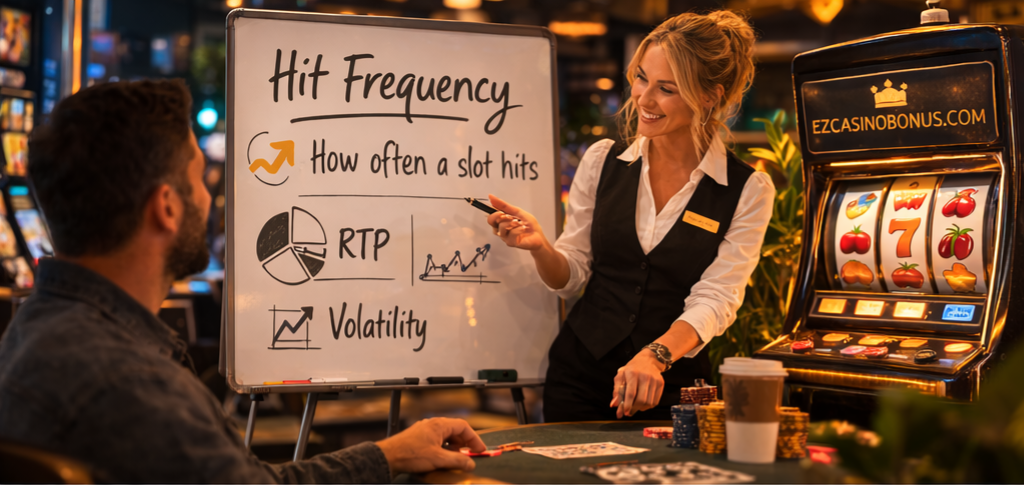
Hit frequency is a slot statistic that describes how often a game produces a winning result. It is usually expressed as a percentage and shows the likelihood that a spin will return any payout, regardless of the amount won.
While many players focus on RTP and volatility, hit frequency provides an additional layer of insight into how a slot behaves during gameplay.
Understanding hit frequency can help explain why some slots appear to win regularly while others can go through long losing streaks.
Marcus Lindahl writes and edits the guides and casino listings on EZCasinoBonus. He works from primary sources rather than from other affiliate sites: where a page states a rule it names the instrument, from Article 29(1) of Malta's Player Protection Directive on payout times to the Kansspelautoriteit's own requirements on bonuses, so any claim can be checked in a click. He covers international markets rather than one country, and the pages say so when a rule applies in only one place. Where a figure cannot be sourced, the pages say so rather than estimating one, and they are updated when the rules change, which in gambling regulation is often.
Hit frequency is the percentage of spins on which a game registers a win. A slot with a 25% hit frequency produces a winning outcome on roughly one spin in four over a large sample. The definition sounds simple and it contains the thing that makes the number so widely misread.
The short answer: It counts any registered win, including wins that return less than you staked. A 30% hit frequency is not a 30% chance of ending a spin ahead, and on many games a large share of those hits are net losses presented as wins.
What Counts as a Hit
The game does not distinguish between a win that returns twenty cents on a one euro spin and one that returns fifty euro. Both are hits. Both trigger the win animation, the sound, and the counter that ticks the balance upward before the next spin takes it back down.
So a single number covers two quite different events, and the ratio between them is not published anywhere. That gap is not an accident of measurement, it is a design feature, and it has a name: a spin that pays back less than it cost while presenting itself as a win is one of the most studied mechanics in slot design and it is what a high hit frequency usually delivers.
€1 spin outcome
Counted as a hit
Effect on the balance
Returns €0.20
Yes
Down €0.80
Returns €0.50
Yes
Down €0.50
Returns €1.00
Yes
Unchanged
Returns €4.00
Yes
Up €3.00
Returns nothing
No
Down €1.00
Four of the five rows are hits and only one of them leaves you ahead. That is the whole of the misreading, laid out.
The reframe worth keeping: Read hit frequency as how often the game will do something, not as how often you will win. It is a measure of pace and texture rather than of profit, and nothing about it points at whether a game returns well.
What the Number Is Actually Useful For
Three real uses, and they are all about the shape of a session rather than its outcome.
Predicting pace. A high hit frequency game feels busy and rarely goes quiet, which some players want and others find exhausting.
Estimating how long a balance lasts in practice. Frequent partial returns extend a session at the same expected loss, which matters when the aim is turnover.
Understanding where a game keeps its money. A low hit frequency means the return is concentrated somewhere, usually in a feature, which is a statement about how widely the game’s results spread rather than about how much it returns.
What it is not useful for is comparing value. A 40% hit frequency game and a 15% one can have identical returns, and neither number tells you which build the operator is running, which the return to player figure in the information panel does.
Why a Losing Streak Does Not Change the Next Spin
Hit frequency is a long run average and not a schedule. The GLI-11 standard requires that random number generator selections are statistically independent and unpredictable, and testing includes serial correlation checks specifically to confirm that outcomes do not depend on previous games.
A game with a 25% hit frequency is therefore not due after three losing spins, and thirty losing spins in a row on such a game is unremarkable rather than evidence of anything. The mechanics behind that, and what certification does and does not establish, are on whether a slot can respond to how you have been playing.
Finding the Figure
Hit frequency is published far less consistently than return to player. Some studios state it in the game information panel, some publish it in press material, and many never publish it at all. No standard requires it, which is a contrast with return to player, where Malta sets a minimum of 85% for any game that has one.
Where it is not published, the usable substitutes are the paytable and the maximum win multiple. A game with many low value symbol combinations and a modest ceiling is a high hit frequency game whether or not anyone says so, and a game whose return is concentrated in a rare feature is not.
Reading Pace Rather Than Value
Hit frequency is worth understanding mainly so that it stops being persuasive. The number describes how often something happens on screen, and the screen is designed to make that feel like winning even when the balance says otherwise. A player who reads a 35% hit frequency as a busy game rather than as good odds is reading it correctly.
For value, the figure to use is the return to player in the game’s own panel at the casino you are playing at, and for the shape of the session, the maximum win multiple. The casinos grouped by software provider are the practical way to find the studios whose game design suits how you like to play, and the real money casinos available in your country narrow that to what you can actually open.
Frequently Asked Questions
There is no good figure, because hit frequency is unrelated to return. Roughly 20% to 30% is common on video slots. A higher number means a busier game rather than a better one.
It means 30% of spins register a win, including wins that return less than the stake. On many games a large share of those leave the balance lower than before the spin.
No. Return to player is how much comes back over the long run, and hit frequency is how often anything comes back. Two games with the same return can have very different hit frequencies.
Sometimes in the information panel, sometimes in studio press material, and often nowhere. No standard requires publication, unlike return to player which Malta requires to be at least 85%.
No. Certification testing requires outcomes to be statistically independent, with serial correlation tests specifically checking that results do not depend on previous games.
Generally yes. A game returning the same amount overall but hitting more often must pay less each time, which is why frequent hitters concentrate on small multiples of the stake.
Indirectly. Frequent partial returns extend a session at the same expected loss, which produces more turnover from the same balance, and turnover is what a wagering requirement measures.
Because the game registers any return as a win and presents it with the same sound and animation. It is a deliberate design choice and the reason hit frequency is easy to misread.
To provide a good experience, we use technologies such as cookies to store and/or access device information. When you consent to these technologies, we may process data such as browsing behavior or unique IDs on this website. If you do not consent or if you withdraw your consent, this may negatively affect some features.
Functional
Always active
The technical storage or access is strictly necessary for the legitimate purpose of enabling the use of a specific service explicitly requested by the subscriber or user, or for the sole purpose of carrying out the transmission of a communication over an electronic communications network.
Alternative
The technical storage or access is necessary for the legitimate purpose of storing settings that are not requested by the subscriber or user.
Statistics
The technical storage or access used exclusively for statistical purposes.The technical storage or access used exclusively for anonymous statistical purposes. Without a subpoena, voluntary compliance by your ISP, or additional records from a third party, information stored or retrieved solely for this purpose generally cannot be used to identify you.
Marketing
The technical storage or access is required to create user profiles to send advertising, or to track the user on a website or across multiple websites for similar marketing purposes.